

Hoffman’s Iron Law
by Richard Henthorne
Hofman's Iron Law is called that because well…folks thought it couldn't be broken.
Truth be told it cannot, but we do have the solution for you…
Before the solution, let's take a look at what Hofmann's Iron Law is all about.
The origin of this name comes from the early 1960's by Anthony Hofmann (the H in KLH), Hofmann's Iron Law is a mathematical formula that was later refined by Thiele and Small, whose work now forms the basis of all modern loudspeaker design. Hofmann's Iron Law is a fundamental principle in speaker design that states a designer can only achieve two out of three core goals: deep bass, small enclosure size, and high efficiency.
Essentially you can have a speaker that can be large, with a massive enclosure and have good efficiency AND low bass capability. You can also have a small woofer with tremendous xmax, good low-bass capability however you will not have very good efficiency.
This is akin to the old hot rod saying , “A car can be cheap, fast or reliable, pick two”.
It will not be all three.
Modern speaker designs have been able to utilize small enclosures, woofers with significant xmax (Stroke), reasonably low resonant frequencies however the one thing that is not high is efficiency.
To get the most out of this setup you will need power, and the ability to drive complex loads.
The good news is, Aragon amplifiers deliver power in spades with both control and speed. We actually get all THREE points. Our Titanium stereo amplifier is conservatively rated at 200 watts and every example that leaves the line, benchmarks at greater than 320 Watts at 8 ohms. This conservative nature and being able to drive impedances to below two ohms will let you drive any of these modern speaker designs to amazing levels. And better yet, our Iridium monoblock delivers 400 conservatively rated Watts and each one testing at greater than 600 leaving the line.
What is all this power without control?
Why do you need control? As woofer design has evolved, excursion or xmax is increased and so has the byproduct of having a long stroke woofer with a strong motor: back EMF. The only solution to having a good sound is to control that back EMF, control the woofers movement and this is referred to in industry as damping factor. This is generally expressed as a relationship between the output and nominal impedance of the amplifier and the speaker respectively. The Titanium and Iridium offer great real world damping factors measured at the output binding posts, numbers that will matter in YOUR room. The only place where all of this means anything real.
But with great power and great control you still need speed…
There's no point in spending serious coin on a speaker and having your amplifier be a weak link in your chain. As tweeters have become lighter and woofer motors have become stronger with lower inductance, the amplifier slew rate can become a weak link in your audio system.
Slew rate is the amplifier’s speed. It’s essentially how many volts the amp can rise over a given time, in this industry standard spec, a whopping microsecond. Pretty neat stuff.
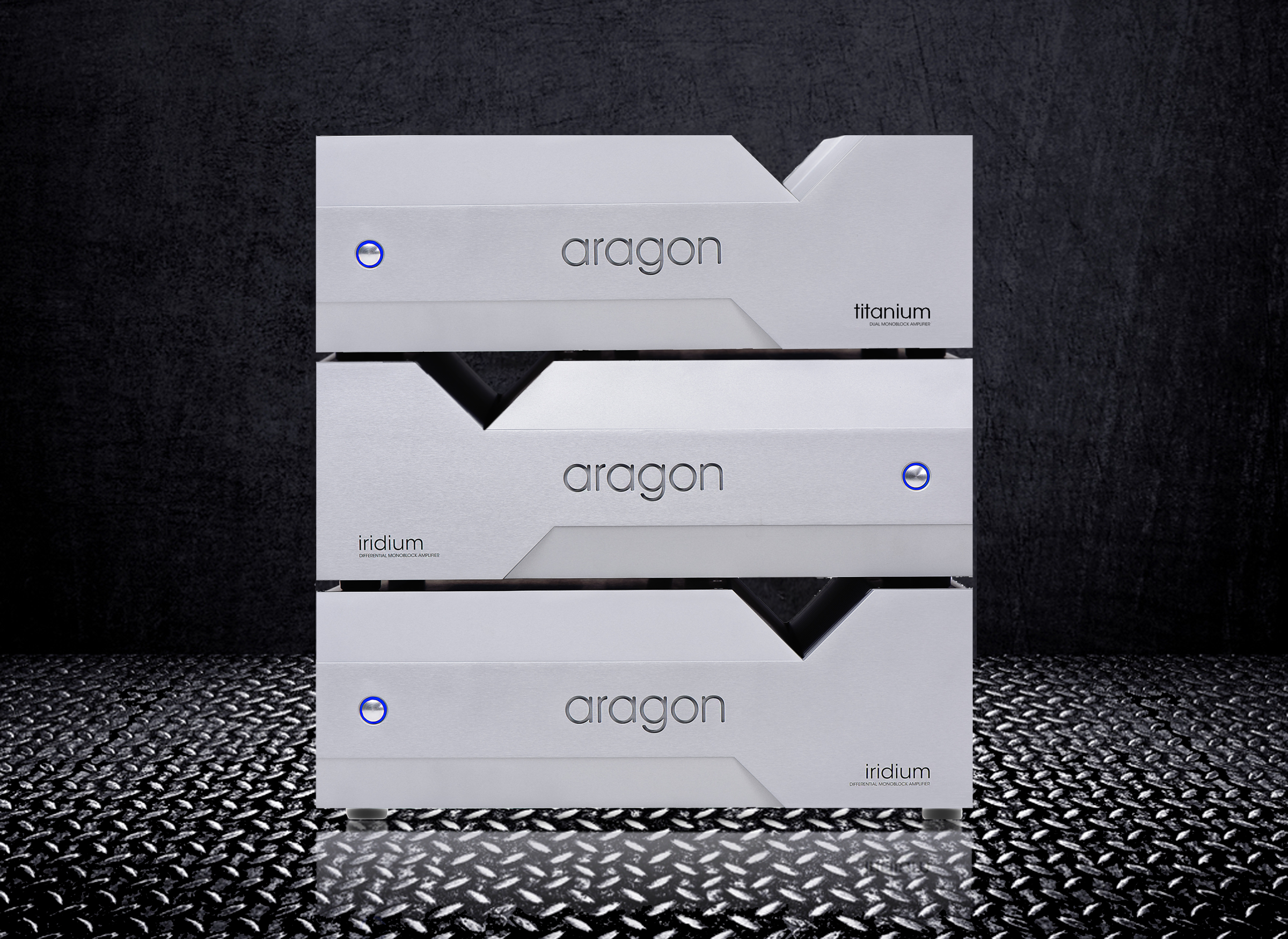
Stack of Aragon Titanium and Iridium
The Titanium delivers an impressive 120 volts per microsecond slew rate. That is 3 to 4x the industry average. The Iridium takes us a step further and doubles down. This is not a gimmick, a trick measurement – it's an honest product capable of rising 240 v in a single microsecond. Some manufacturers will quote the speed of the feedback loop or a single part of the amplifier and give you misleading figures. This is truly a class leading benchmark of a figure.
When it comes to amps, there may not be a figure like Hofmann's Iron Law but we feel we are giving you the trifecta:
Great power
Great control
Great speed
Aragon delivers on all of these fronts, every time.